Maximapark
Three hundred hectares of new landscape west of the city: a six-kilometre pergola ring, a Piet Oudolf perennial garden that peaks in September, and a reconstructed Roman fort with a real ship inside — the clearest proof that Utrecht builds nature into its suburbs rather than around them.
 Piet Oudolf perennial planting in the Vlinderhof, Maximapark, Leidsche Rijn
What to expect at Maximapark
Maximapark is the green heart designed into Leidsche Rijn, the vast expansion district Utrecht began building west of the Amsterdam-Rhine Canal in the 1990s. At roughly 300 hectares it is one of the largest city parks in the Netherlands, and unusually it was planned before most of the housing around it, so the park sets the terms rather than filling the gaps. Its defining structure is the Binnenhof, a circuit of some six kilometres enclosed by a continuous pergola of steel and climbing plants that frames an inner landscape of meadows, orchards, water and gardens. Around it lie sports fields, allotments, reed-fringed waterways and the reconstructed Roman fort of Castellum Hoge Woerd. It is a deliberately contemporary landscape, and it is the single best place to understand how the region thinks about nature, density and sustainability at once.
Walking it, the park reveals itself in rooms. The Vlinderhof, a butterfly garden planted to a design by Piet Oudolf and maintained largely by volunteers, is the horticultural highlight: drifts of perennials and grasses that look loose in June, glorious in late August and September, and skeletal but photogenic in winter. Elsewhere there are orchard meadows, a Japanese-inspired corner, long grass paths where hares bolt at dusk, ponds with herons and a good scattering of playgrounds and paddling areas for children. In the southwest corner the Castellum rises from the ground plan of a genuine Roman fort excavated on the spot, and inside its museum lies the De Meern 1 Roman river ship, recovered from the mud nearby. The scale means you choose a route rather than see everything.
Plan around the pergola. The full Binnenhof circuit is about six kilometres and takes 75-90 minutes on foot or 25 minutes on a bike, and it is the simplest way to not get lost in a park with many entrances and few obvious landmarks. If you have two hours, do the northern half plus the Vlinderhof; if you have half a day, add the Castellum and its museum. Bikes are the local answer and make the whole park usable in an afternoon. There is little shade on the open meadows, so a hat matters in July, and the paths are exposed to wind off the polder in winter. Download or photograph a park map at the entrance boards, because signage inside the ring is patchy.
Getting there is a short train ride rather than a slog. From Utrecht Centraal, sprinter trains reach Utrecht Terwijde in about seven minutes and Vleuten in around eleven, both for a fare of roughly €2-3; from either station the park edge is a 5-10 minute walk. Buses serve Leidsche Rijn from the centre but take longer. By bike it is 25-35 minutes from the Dom, mostly on separated cycle paths through Lombok and over the canal, and this is genuinely the nicest approach. Drivers will find parking at the park edges and near Castellum Hoge Woerd, generally free or low-cost compared with the centre, which makes this one of the few Utrecht attractions where the car is not a mistake.
There is no entry charge for any part of the park, including the Vlinderhof, the playgrounds, the pergola circuit and the outer grounds of the Roman fort. The only ticket in the whole 300 hectares is the museum inside Castellum Hoge Woerd, where admission is modest — expect single-figure euros for adults, with reductions for children and free entry for Museumkaart holders — and where the theatre programmes separately priced performances. Refreshments come from the small cafes at the Castellum and near the main play areas, with coffee about €3 and lunch dishes €8-15. A bike rental in the centre at €10-15 a day is the other realistic cost, and it is the one worth paying.
Season is everything here. The Vlinderhof runs from a quiet green June through a peak in late August and September, when the perennials and grasses are at full height and butterflies are thick over the sedums; October leaves rust-coloured seed heads that many visitors prefer. Spring brings blossom in the orchard meadows and nesting birds along the waterways. Midwinter is bleak on the open meadows but the pergola still gives structure and the paths drain well. Hour by hour, early morning is the quiet window for wildlife and photographs; weekend afternoons in summer bring families to the play areas and cyclists to the ring, though the park is so large it never feels crowded away from the playgrounds.
It suits cyclists, garden lovers, families and anyone tired of the compact old centre. Wheelchair users and pushchairs do well on the asphalt and hard-gravel routes, including the whole pergola circuit and the approach to the Castellum, though some meadow paths are grass and soft in winter. Families get several distinct playgrounds and shallow water play. Teenagers will need bikes to stay interested. It is a poor choice in heavy rain, since shelter is limited to the pergola and the Castellum. Anyone with a single afternoon in Utrecht and a taste for old cities should skip it entirely and stay on the Oudegracht — this is a park for a second or third day.
Nearby, the obvious pairing is Castellum Hoge Woerd itself, inside the park, which makes a good hour for Roman history and shipbuilding. Vleuten village, ten minutes on foot from its station, has old brickwork, a church and a couple of terraces. The Leidsche Rijn canal path runs east back towards the city and is the standard cycling route home, passing new architecture that architecture enthusiasts genuinely detour for. If you are working through the region by bike, the Kromme Rijn and the Amelisweerd estates lie on the opposite side of Utrecht, roughly an hour away across the city, and make the natural next day out.
The honest caveats: this is a young landscape, and it looks it. Tree cover is thin outside the older estate corners, some sections read as engineered grass and drainage rather than nature, and on a grey February afternoon it can feel oddly empty for a park that size. The pergola is impressive as an idea but is not uniformly planted along its whole length. Signage inside the ring is inconsistent and it is easy to walk twenty minutes in the wrong direction. And do not come for the Vlinderhof alone in April or May — it is a late-summer garden, and visitors who arrive in spring expecting tulips are in the wrong country's cliche and the wrong month.
Questions about Maximapark
The park is entirely free, including the Vlinderhof garden, all playgrounds, the pergola circuit and the outdoor grounds of Castellum Hoge Woerd. The only paid element is the museum inside the Roman fort, which charges a modest single-figure sum for adults with child reductions, and is free for Museumkaart holders. Food and drink at the small park cafes runs about €3 for coffee and €8-15 for lunch. Parking at the park edges is free or low cost, unlike the city centre.
The park has no gates and no ticket at any hour, so the whole of it is free permanently, day and night. The Vlinderhof is open in daylight and, being volunteer-run, occasionally has planting or maintenance days when parts are roped off. The only timed access is the Castellum Hoge Woerd museum, open Tuesday to Sunday roughly 11:00-17:00, which is where any admission charge applies and where Museumkaart holders enter without paying.
Two to four hours, and more if you cycle. Walking the six-kilometre pergola ring alone takes 75-90 minutes; on a bike the same loop is about 25 minutes, which leaves time for the Vlinderhof and a playground stop. A half day covers the ring, the garden, a cafe and the Roman fort museum. If you only have an hour, take the train to Terwijde, walk to the Vlinderhof and back, and accept that you have seen a fraction.
The park never closes and is accessible around the clock. The museum inside Castellum Hoge Woerd closes on Mondays and on some public holidays, which catches out visitors planning a Monday day out west. Water play features are seasonal and switched off in cold months. After severe storms, individual wooded or pergola sections can be taped off while damaged planting is cleared, but the main circuit almost always stays walkable.
Not for the park. Walking, cycling, the Vlinderhof and the playgrounds all work on arrival with no reservation. Book only if you want a theatre performance at Castellum Hoge Woerd, where the auditorium is small and shows sell out, or a guided garden tour on one of the volunteer open days. Bike rental in the city centre is worth reserving on summer weekends, since shops near Utrecht Centraal run out of bikes by mid-morning.
Utrecht Terwijde station is about seven minutes from Utrecht Centraal by sprinter and a 5-10 minute walk from the park; Vleuten station is around eleven minutes out and equally close to the western edge. Rail fares are roughly €2-3 each way. By bike allow 25-35 minutes from the Dom on separated cycle paths through Lombok. Drivers will find edge-of-park and Castellum parking that is free or far cheaper than central Utrecht garages.
Hotels near Maximapark

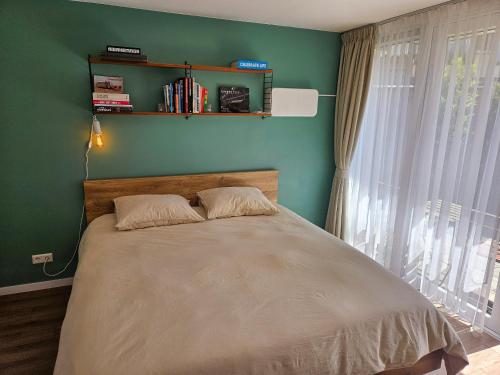
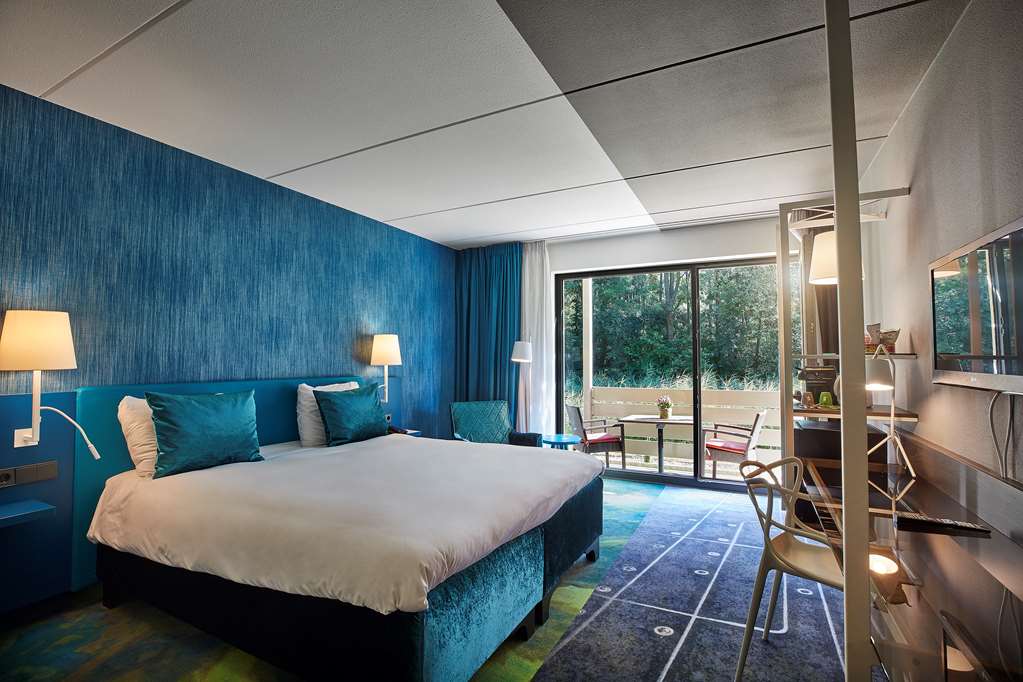
Every hotel we cover in Leidsche Rijn
- Het Dijkje Utrecht 3★ · 0.9 km away
- Guest Room Utrecht 4★ · 1.1 km away
- Eco lodge Utrecht Leidsche Rijn 3★ · 2.2 km away
More things to do
All things to do

From the journal
All posts Comparisons & rankings
Hotels with free parking in Utrecht, ranked
Comparisons & rankings
Hotels with free parking in Utrecht, ranked
On-street parking inside Utrecht's canal ring can pass €5 an hour and a central hotel space costs €20-30 a night, so here are 8 kinds of hotel that throw the car in for nothing — and the ride into town each one leaves you with.
 Comparisons & rankings
Best family-friendly hotels in Utrecht, ranked
Comparisons & rankings
Best family-friendly hotels in Utrecht, ranked
Utrecht's prettiest hotels are 17th-century canal houses with 40 steps and no lift, so here are 8 places-and-types that actually work with children — plus the €0-€25 attractions that justify each location.
 Comparisons & rankings
Pet-friendly hotels in Utrecht, ranked
Comparisons & rankings
Pet-friendly hotels in Utrecht, ranked
Most Utrecht hotels take dogs for €10-20 a night, but only a few give you somewhere to walk one at 07:00 — here are 7 areas and hotel types ranked on exactly that, plus the off-leash woods worth the ride.